
Star Trek: The Next Generation Episode Guide: Best Episodes
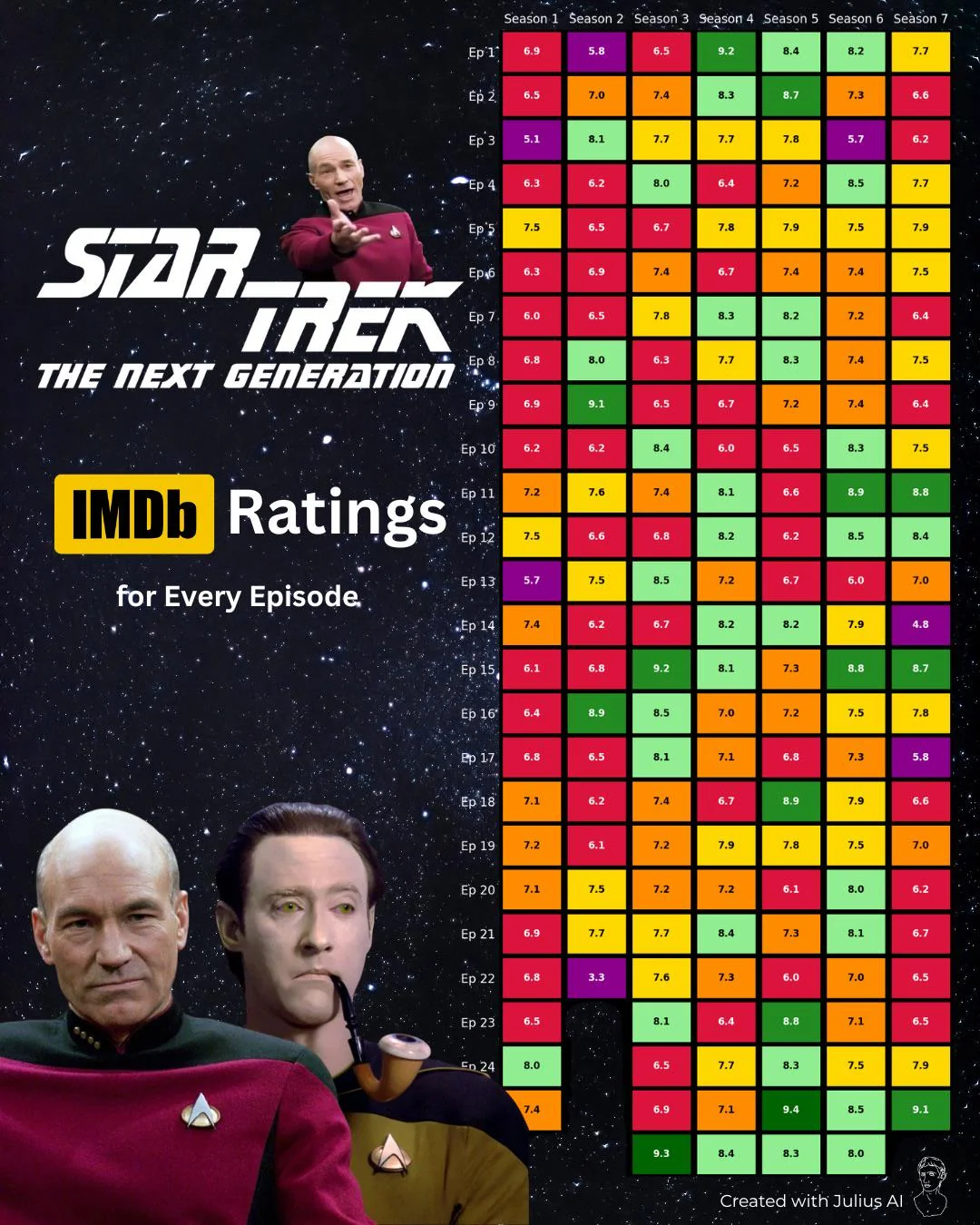
Star Trek The Next Generation ran for seven seasons and 178 episodes, which can feel daunting for newcomers. This TNG episode guide explains how the series is organised, which seasons are strongest and which best episodes make the easiest way in.
What Star Trek The Next Generation is
The series launched in the autumn of 1987 and ended in 1994. It is set roughly a century after the original Star Trek, aboard a new starship Enterprise. Patrick Stewart plays Captain Jean-Luc Picard, a diplomatic, thoughtful commander who prefers talking to fighting.
He leads a large ensemble: Jonathan Frakes as Commander Riker, Brent Spiner as the android Data, LeVar Burton as Geordi La Forge, Michael Dorn as Worf, Gates McFadden as Dr Crusher and Marina Sirtis as Counsellor Troi. Most episodes are self-contained, so you can dip in without much prior knowledge.
TNG episode guide: season by season
| Season | Years | Episodes | In brief |
|---|---|---|---|
| 1 | 1987–88 | 26 | Uneven, but it sets up the crew and introduces Q |
| 2 | 1988–89 | 22 | Shortened by a writers' strike, with a clear step up in quality |
| 3 | 1989–90 | 26 | The turning point, with stronger stories and a famous cliffhanger |
| 4 | 1990–91 | 26 | Confident, character-led storytelling |
| 5 | 1991–92 | 26 | Many fans' favourite run |
| 6 | 1992–93 | 26 | Darker and more varied |
| 7 | 1993–94 | 26 | A mixed year that ends on a strong finale |
The early seasons
The first season is the hardest sell. The premiere, Encounter at Farpoint, introduces the crew and the mischievous Q, but many early stories feel stiff. Season two improves, and season three is where the show finds its voice.
The middle and later seasons
Seasons four and five balance big ideas with quieter character drama. Season six has some of the series' most intense hours, while season seven is patchier but closes well.
The best episodes to start with
There is no need to begin at the very beginning. These ten episodes show what the series does best, and each works with little background knowledge.
- The Measure of a Man (season 2): a hearing decides whether Data is a person or property. It is a compact, moving courtroom drama.
- Q Who (season 2): Q hurls the Enterprise across space, where the crew meet the Borg for the first time.
- Sins of the Father (season 3): Worf's family honour is challenged, and the Klingon Empire becomes far richer as a setting.
- Yesterday's Enterprise (season 3): a rift in time brings a battered older Enterprise into view, and a war that should not exist.
- The Best of Both Worlds (seasons 3 and 4): the Borg capture Picard in a two-part story. It is the series' best-known cliffhanger.
- Family (season 4): a gentle, human aftermath episode in which Picard returns to his family's vineyard in France.
- Darmok (season 5): Picard is stranded with an alien captain whose language works through stories and references.
- Cause and Effect (season 5): a time-loop puzzle that is clever, tense and often funny.
- The Inner Light (season 5): Picard lives an entire lifetime on a vanished world in a few minutes. It is among Stewart's finest performances.
- Chain of Command (season 6): a two-part tale in which Picard is interrogated by a Cardassian officer, played by David Warner.
If you want a lighter pick, Tapestry in season six lets Q give Picard a chance to rewrite his youth. For a gripping conspiracy story, try The Drumhead in season four.
A suggested viewing route
For a quick introduction, watch The Measure of a Man first, then Q Who and The Best of Both Worlds. These give you the ethical debates, the biggest threat and the show's emotional centre in just a few hours.
If you would rather watch in order, start with season one, but expect some rough patches. Many fans suggest sampling a few season one episodes, then moving on to the stronger season two and three material.
Where TNG fits in the wider franchise
As Star Trek TV goes, TNG is a useful hub. It led to Deep Space Nine and Voyager, and to four feature films with the same crew: Generations, First Contact, Insurrection and Nemesis. Stewart later returned as Picard in a separate series on Paramount+.
The finale, All Good Things..., is worth saving until the end. It rewards viewers who have followed Picard and his crew through the years.
The takeaway
TNG's reputation rests on its optimism, its ensemble and its willingness to turn a science fiction premise into a moral question. You do not need to see every episode to appreciate it. Start with the best episodes above, follow whatever hooks you, and fill in the gaps later.