
The Odyssey (2026): Nolan's Homer Epic, Cast and Box Office
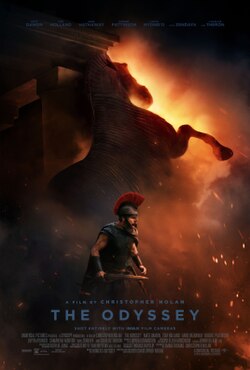
Christopher Nolan's The Odyssey is a big-screen retelling of Homer's ancient poem about a warrior trying to get home after the Trojan War. Released in July 2026, it became one of the year's biggest films and the highest-grossing of Nolan's career.
What is The Odyssey about?
The film follows Odysseus, the king of Ithaca, on his long and dangerous journey back to his family after the fall of Troy. Along the way he faces sea voyages, supernatural encounters and the temptations that delay his return. At home, his absence leaves his household vulnerable.
Nolan wrote the screenplay himself, working from Homer's text. Reviewers noted that the film treats the story's fantastical elements with a grounded, physical realism rather than leaning on obvious spectacle for its own sake. It also plays with time, moving between moments rather than telling the tale in a straight line.
Cast and crew
Matt Damon plays Odysseus, reuniting with Nolan after his supporting role in Oppenheimer. The ensemble is large and includes:
- Tom Holland
- Anne Hathaway
- Robert Pattinson
- Lupita Nyong'o
- Zendaya
- Charlize Theron
- Samantha Morton
- John Leguizamo
- Mia Goth
- Jon Bernthal
- Elliot Page
Samantha Morton's turn as the enchantress Circe drew some of the strongest praise from critics. Behind the camera, Nolan is joined by several regular collaborators: cinematographer Hoyte van Hoytema, editor Jennifer Lame and composer Ludwig Göransson. Emma Thomas produced with Nolan.
A film made for IMAX
The production's headline technical claim is that it is the first feature shot entirely on IMAX 70mm film cameras. Those cameras are heavy and awkward to work with, so the choice made the shoot a significant logistical challenge. Nolan has long preferred practical locations and in-camera effects to heavy use of computer-generated imagery, and that approach continues here.
The format shaped how audiences chose to see it. Premium large screens accounted for a major share of the opening weekend, and the few IMAX 70mm venues, of which there are only a few dozen globally, sold out well in advance. The film returned to select IMAX screens from 9 October 2026 for a further run.
Runtime and rating
The film runs for roughly 172 to 173 minutes, depending on the source. In the United States it carries an R rating for violence and some language. Its hard rating did not stop it from becoming the highest-grossing R-rated film ever released.
Release and box office
Universal Pictures released the film on 17 July 2026 in the US and UK, with previews the day before. It opened to about $124.5 million in North America and $264.1 million globally. That was Nolan's biggest international launch, ahead of The Dark Knight Rises.
The second weekend was strong too, with a drop of only around 27 per cent in North America, even with a major superhero release arriving soon afterwards. The film passed $1 billion globally in August. It has since reached about $1.79 billion, making it:
- Nolan's highest-grossing film
- The second-highest-grossing film of 2026
- The highest-grossing film Universal has ever distributed
- One of the dozen biggest earners of all time
Budget figures vary between reports. The most widely cited estimate is around $250 million, which would make it one of the costliest films of Nolan's career.
How critics responded
Reviews were largely glowing. The film scored in the mid-90s on Rotten Tomatoes' critics' measure, and the audience score was similar. Critics singled out the scale of the set pieces, the IMAX photography, Göransson's score and the performances, with Damon's turn and Morton's Circe frequently mentioned.
There were reservations. Some reviewers found the film more monumental than emotionally moving, and one major trade review described it as a little aloof. Others took issue with Nolan's departures from Homer. The dialogue also divided opinion: the cast speak in modern, American-sounding English rather than the formal, classical British delivery of many earlier screen versions. Supporters saw that as making the characters relatable, while others found it jarring.
Where it sits in Nolan's career
This is Nolan's first film since Oppenheimer, which won seven Academy Awards, including Best Picture and his first Best Director Oscar. The Odyssey shows him taking on a very different kind of material. Where Oppenheimer was a dense historical drama, this is a mythic adventure that leans on action and spectacle, though it keeps his interest in memory, chance and fate.
The bottom line
Nolan's The Odyssey pairs one of literature's oldest stories with some of cinema's most demanding technology. Critics and audiences have broadly embraced it, and the box office has been exceptional. If you want to judge it for yourself, a large-format screen is the way the film was designed to be seen.